How Much Gravel Do You Need for a Driveway? A Layer-by-Layer Calculation
Ordering gravel for a driveway is a numbers problem with an expensive failure mode. Order too little and the truck comes back for a second delivery fee. Order too much and you have a pile of crushed stone on the lawn. Spread it too thin and the driveway ruts within a season.
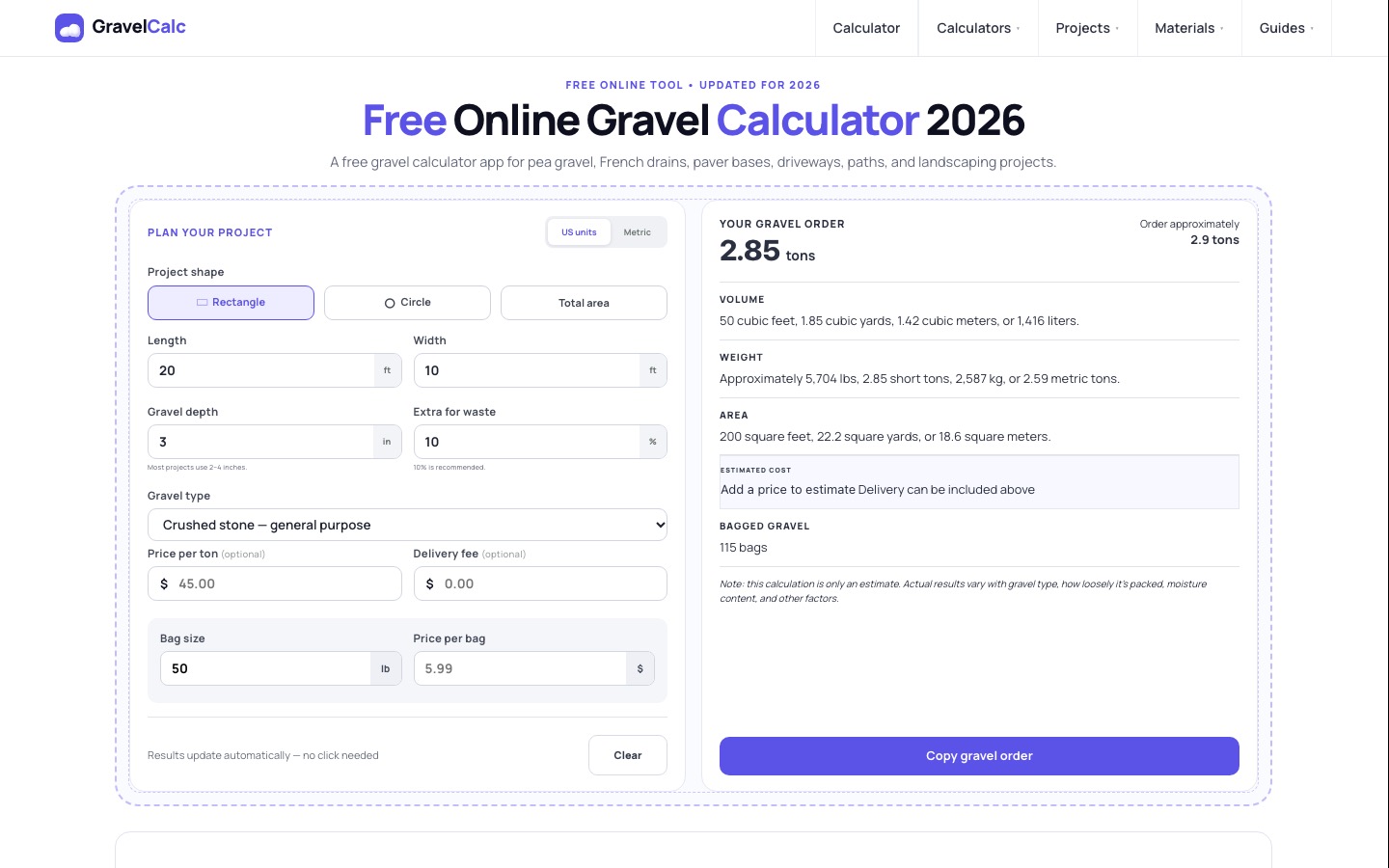
This guide walks through how much gravel a driveway needs: which layers to plan for, how deep each should be, the formula for turning dimensions into tons, and worked examples for common driveway sizes. You can follow the math by hand or check your numbers with a driveway gravel calculator.
A gravel driveway is layers, not one pile
The most common mistake is treating a driveway as a single layer of stone. A durable gravel driveway is usually built in layers, each doing a different job:
- Compacted subgrade: the native soil, graded and compacted.
- Landscape fabric (optional but common): keeps the stone from sinking into soft soil.
- Base layer: larger crushed stone that spreads vehicle weight and drains water.
- Surface layer: smaller angular stone that forms the driving surface.
Because the layers use different materials, you calculate and order them separately. One deep pour of a single stone size rarely performs as well.
How deep should driveway gravel be?
Depth depends on what drives on it and how soft the ground is. These are typical starting points for residential driveways:
| Driveway use | Surface layer | Base layer |
|---|---|---|
| Passenger cars, light use | about 4 in | about 6 in |
| Daily family vehicles | 4–6 in | 6–8 in |
| Trucks, RVs, trailers | 6–8 in | about 8 in |
| Top-up of an existing driveway | 2–3 in | none |
Soft clay, poor drainage or frequent heavy loads push you toward the deeper end. If you’re unsure, the guide on how deep gravel should be covers depth by project type.
Choosing the right driveway stone
The surface material matters as much as the depth. Driveway stone needs to lock together under turning tires.
- #57 crushed stone: angular pieces roughly 3/4 to 1 inch that interlock and drain well. A common choice for the surface layer.
- Crusher run (also called dense grade or quarry process): crushed stone mixed with stone dust, which compacts to a firm, almost solid layer. Popular for base layers and rural driveways, though it can be dusty and drains less freely.
- Pea gravel: small and rounded. It looks good in borders, but it rolls underfoot and shifts under tires, so it’s a poor main driving surface.
If you’re planning a crusher run base, a dedicated crusher run calculator uses that material’s density rather than a generic one.
The driveway gravel formula
Gravel is measured by volume (cubic yards) and usually sold by weight (tons). The calculation has four steps:
1. Area (sq ft)        = length (ft) × width (ft)
2. Depth (ft)          = depth (in) ÷ 12
3. Volume (cubic yd)   = area × depth ÷ 27
4. Weight (tons)       = cubic yards × density (tons per cubic yard)
Then add a waste allowance. Driveways compact under traffic and the ground is never perfectly flat, so roughly 10–15% extra is a common buffer.
About density: crushed stone is often estimated at around 1.4–1.6 tons per cubic yard, and 1.5 is a reasonable middle value. Your supplier’s figure for their specific material is always better. To convert volume to weight for a particular stone, use a cubic yards to tons calculator.
Worked examples for common driveway sizes
The examples below use 1.5 tons per cubic yard and a 15% waste allowance. The surface and base layers are calculated separately.
Single-car driveway, 12 × 20 ft, 5-inch surface layer
- Area: 12 × 20 = 240 sq ft
- Volume: 240 × (5 ÷ 12) ÷ 27 = 3.7 cubic yards
- Weight: 3.7 × 1.5 = 5.6 tons
- Order: about 6.4 tons with 15% extra
Double-car driveway, 20 × 20 ft, 5-inch surface layer
- Area: 400 sq ft
- Volume: 400 × 0.417 ÷ 27 = 6.2 cubic yards
- Weight: 6.2 × 1.5 = 9.3 tons
- Order: about 10.6 tons
Long driveway, 12 × 50 ft, 4-inch surface plus 6-inch base
- Surface: 600 × (4 ÷ 12) ÷ 27 = 7.4 cubic yards → 11.1 tons → order about 12.8 tons
- Base: 600 × (6 ÷ 12) ÷ 27 = 11.1 cubic yards → 16.7 tons → order about 19.2 tons
- Total: roughly 32 tons across two materials
The last example shows why layering matters for budgeting. The base layer is often the larger order, and people who forget it underestimate by half or more.
Estimating driveway gravel cost
Material cost is tons × price per ton, plus delivery. Bulk crushed stone prices vary widely by region, quarry distance and order size, so call two or three local suppliers before relying on any national figure. Ask about:
- The price per ton for each material, since base and surface stone are priced differently
- Delivery fees and any minimum order
- Whether they will spread (“tailgate”) the load or just dump it
A gravel driveway cost calculator can turn your tonnage and local prices into a budget that includes delivery.
Common mistakes to avoid
- Measuring only the driving lane. Add a foot or two on each side if you want shoulders or edging.
- Skipping the base. Surface stone laid straight on soil tends to sink and rut, especially on clay.
- Using one density for everything. Crusher run, #57 stone and pea gravel weigh different amounts per cubic yard.
- Spreading in one thick lift. Lay and compact the base in layers of a few inches at a time for a firmer result.
- Ordering exact numbers. Round up. A small surplus is cheaper than a second delivery.
FAQ
How many tons of gravel do I need for a 20 × 20 driveway?
At a 5-inch surface depth and 1.5 tons per cubic yard, a 20 × 20 driveway needs about 9.3 tons of gravel, or roughly 10.6 tons with a 15% allowance. A base layer is calculated and ordered separately.
What is the best gravel for a driveway?
Angular crushed stone such as #57 is a common surface choice because it interlocks and drains. Crusher run is popular for base layers. Rounded pea gravel isn’t recommended as the main driving surface.
How deep should gravel be for a driveway?
For typical passenger vehicles, plan on about 4–6 inches of surface stone over 6–8 inches of base. Heavier vehicles and soft soil call for more.
Conclusion
Working out how much gravel a driveway needs comes down to three decisions: the layers you’ll build, the depth of each, and the density of each material. Measure the area, convert depth to feet, divide by 27 for cubic yards, multiply by density for tons and round up. To skip the arithmetic, or to check yours, plug your dimensions into the free driveway gravel calculator and confirm the final quantities with your supplier.